



Click Below to Get the Code

Browse, clone, and build from real-world templates powered by Harper.
Case Study
GitHub Logo

The Impact of Early Hints - Auto Parts

A leading U.S. auto parts retailer used Harper’s Early Hints technology to overcome Core Web Vitals failures, achieving faster load speeds, dramatically improved indexation, and an estimated $8.6M annual revenue uplift. With minimal code changes, the proof-of-concept validated that even small performance gains can unlock significant growth opportunities for large-scale e-commerce businesses.
Early Hints
Case Study
Early Hints

The Impact of Early Hints - Auto Parts

Harper
at Harper
September 17, 2025
Harper
at Harper
September 17, 2025
Harper
at Harper
September 17, 2025
September 17, 2025
A leading U.S. auto parts retailer used Harper’s Early Hints technology to overcome Core Web Vitals failures, achieving faster load speeds, dramatically improved indexation, and an estimated $8.6M annual revenue uplift. With minimal code changes, the proof-of-concept validated that even small performance gains can unlock significant growth opportunities for large-scale e-commerce businesses.
Harper

Summary

A leading U.S. auto parts retailer, recognized for its extensive product catalog and direct-to-consumer business model, was facing growing challenges with site performance and indexation. Despite significant investments in performance optimization, their Core Web Vitals consistently showed failures, limiting growth potential and exposing them to competitive SEO risk.

By implementing Harper’s Early Hints technology in a proof-of-concept (POC), the retailer achieved measurable gains: faster load times, dramatically improved page indexation, and strong leading indicators of revenue uplift. With minimal code changes and a rapid rollout, the results built a compelling business case for scaling performance enhancements across their digital ecosystem.

Context

This retailer manages one of the largest online catalogs in its industry, with millions of unique products and information pages. As customer journeys increasingly began with organic search, site efficiency became a mission-critical factor.

Despite ongoing engineering work, Core Web Vitals (CWVs) consistently underperformed. Google Search Console showed that nearly all URLs were failing or needed improvement across both desktop and mobile. While the site still generated substantial revenue, the lack of CWV “green” scores represented a glass ceiling: further digital marketing spend was yielding diminishing returns, and organic growth potential remained capped.

The leadership team recognized that without a material shift in performance, future revenue growth would stagnate.
The Problem

  • Core Web Vitals failures: Virtually all URLs were flagged as failing or needing improvement.
    SEO growth limits: Even with significant ad spend, organic visibility lagged competitors.
  • Indexation inefficiency: Large portions of the catalog weren’t being surfaced by Google, leaving revenue on the table.
  • Risk of stagnation: Growth was plateauing despite ongoing marketing and infrastructure investments.

The Solution: Early Hints

Harper partnered with the retailer to run a focused 30-day proof-of-concept test on the retailer’s production website. The goal was to validate whether Early Hints—a distributed edge capability that preloads critical assets using HTTP 103—could materially accelerate site speed and improve search engine responsiveness.

Crucially, this required no code refactoring by the client. The solution was activated through platform configuration, allowing Harper’s distributed cloud platform to accelerate time-to-first-byte and largest contentful paint across all browsers and devices.

Within days, the results were clear: Early Hints provided not just performance gains, but measurable business impact.

The Outcome

The proof of concept generated an immediate uplift across both user experience and search visibility:

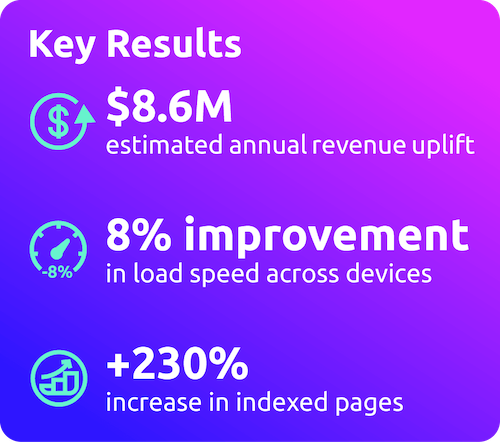
  • Page load speed improved by 8%, cutting average load times by 280ms.
  • Largest Contentful Paint (LCP) improved significantly, moving the retailer closer to “good” thresholds on mobile and desktop.
  • Page indexation surged 230% in just 15 days, moving millions of “crawled not indexed” pages into the live Google SERPs index.
  • Estimated revenue benefit: $8.6M annually, based on conservative industry benchmarks linking performance improvements to conversion rates.

These results validated that even small gains in speed can translate into disproportionate business outcomes for large-scale e-commerce sites. Importantly, the impact extended beyond Core Web Vitals to leading indicators such as crawl rates, impressions, and traffic growth.

Conclusion & Path Forward

The POC demonstrated that Early Hints can unlock hidden growth for retailers managing massive catalogs. For this auto parts leader, the acceleration of page loads led directly to better indexation, more impressions, and higher revenue potential.

While Early Hints delivered immediate wins, the next stage involves building on this momentum: implementing prerendering, advanced caching, and phased infrastructure enhancements. Each step moves the retailer closer to sustained Core Web Vitals “green” scores—ensuring long-term competitiveness in organic search and continued revenue growth.

Summary

A leading U.S. auto parts retailer, recognized for its extensive product catalog and direct-to-consumer business model, was facing growing challenges with site performance and indexation. Despite significant investments in performance optimization, their Core Web Vitals consistently showed failures, limiting growth potential and exposing them to competitive SEO risk.

By implementing Harper’s Early Hints technology in a proof-of-concept (POC), the retailer achieved measurable gains: faster load times, dramatically improved page indexation, and strong leading indicators of revenue uplift. With minimal code changes and a rapid rollout, the results built a compelling business case for scaling performance enhancements across their digital ecosystem.

Context

This retailer manages one of the largest online catalogs in its industry, with millions of unique products and information pages. As customer journeys increasingly began with organic search, site efficiency became a mission-critical factor.

Despite ongoing engineering work, Core Web Vitals (CWVs) consistently underperformed. Google Search Console showed that nearly all URLs were failing or needed improvement across both desktop and mobile. While the site still generated substantial revenue, the lack of CWV “green” scores represented a glass ceiling: further digital marketing spend was yielding diminishing returns, and organic growth potential remained capped.

The leadership team recognized that without a material shift in performance, future revenue growth would stagnate.

The Problem

  • Core Web Vitals failures: Virtually all URLs were flagged as failing or needing improvement.
    SEO growth limits: Even with significant ad spend, organic visibility lagged competitors.
  • Indexation inefficiency: Large portions of the catalog weren’t being surfaced by Google, leaving revenue on the table.
  • Risk of stagnation: Growth was plateauing despite ongoing marketing and infrastructure investments.

The Solution: Early Hints

Harper partnered with the retailer to run a focused 30-day proof-of-concept test on the retailer’s production website. The goal was to validate whether Early Hints—a distributed edge capability that preloads critical assets using HTTP 103—could materially accelerate site speed and improve search engine responsiveness.

Crucially, this required no code refactoring by the client. The solution was activated through platform configuration, allowing Harper’s distributed cloud platform to accelerate time-to-first-byte and largest contentful paint across all browsers and devices.

Within days, the results were clear: Early Hints provided not just performance gains, but measurable business impact.

The Outcome

The proof of concept generated an immediate uplift across both user experience and search visibility:

  • Page load speed improved by 8%, cutting average load times by 280ms.
  • Largest Contentful Paint (LCP) improved significantly, moving the retailer closer to “good” thresholds on mobile and desktop.
  • Page indexation surged 230% in just 15 days, moving millions of “crawled not indexed” pages into the live Google SERPs index.
  • Estimated revenue benefit: $8.6M annually, based on conservative industry benchmarks linking performance improvements to conversion rates.

These results validated that even small gains in speed can translate into disproportionate business outcomes for large-scale e-commerce sites. Importantly, the impact extended beyond Core Web Vitals to leading indicators such as crawl rates, impressions, and traffic growth.

Conclusion & Path Forward

The POC demonstrated that Early Hints can unlock hidden growth for retailers managing massive catalogs. For this auto parts leader, the acceleration of page loads led directly to better indexation, more impressions, and higher revenue potential.

While Early Hints delivered immediate wins, the next stage involves building on this momentum: implementing prerendering, advanced caching, and phased infrastructure enhancements. Each step moves the retailer closer to sustained Core Web Vitals “green” scores—ensuring long-term competitiveness in organic search and continued revenue growth.

A leading U.S. auto parts retailer used Harper’s Early Hints technology to overcome Core Web Vitals failures, achieving faster load speeds, dramatically improved indexation, and an estimated $8.6M annual revenue uplift. With minimal code changes, the proof-of-concept validated that even small performance gains can unlock significant growth opportunities for large-scale e-commerce businesses.

Download

White arrow pointing right
A leading U.S. auto parts retailer used Harper’s Early Hints technology to overcome Core Web Vitals failures, achieving faster load speeds, dramatically improved indexation, and an estimated $8.6M annual revenue uplift. With minimal code changes, the proof-of-concept validated that even small performance gains can unlock significant growth opportunities for large-scale e-commerce businesses.

Download

White arrow pointing right
A leading U.S. auto parts retailer used Harper’s Early Hints technology to overcome Core Web Vitals failures, achieving faster load speeds, dramatically improved indexation, and an estimated $8.6M annual revenue uplift. With minimal code changes, the proof-of-concept validated that even small performance gains can unlock significant growth opportunities for large-scale e-commerce businesses.

Download

White arrow pointing right

Explore Recent Resources

News
GitHub Logo

Harper Recognized as an Honorable Mention in the 2026 Gartner® Magic Quadrant™ for Cloud-Native Application Platforms

Harper’s inclusion highlights a broader shift toward integrated cloud-native platforms that unify data, caching, messaging, and application logic. The article explains how Harper’s distributed runtime and managed infrastructure reduce operational complexity, improve performance, and support modern applications and AI agents that require fast, reliable access to state, events, and tools.
Announcement
News
Harper’s inclusion highlights a broader shift toward integrated cloud-native platforms that unify data, caching, messaging, and application logic. The article explains how Harper’s distributed runtime and managed infrastructure reduce operational complexity, improve performance, and support modern applications and AI agents that require fast, reliable access to state, events, and tools.
Person with short dark hair and moustache, wearing a colorful plaid shirt, smiling outdoors in a forested mountain landscape.
Aleks Haugom
Senior Manager of GTM
News

Harper Recognized as an Honorable Mention in the 2026 Gartner® Magic Quadrant™ for Cloud-Native Application Platforms

Harper’s inclusion highlights a broader shift toward integrated cloud-native platforms that unify data, caching, messaging, and application logic. The article explains how Harper’s distributed runtime and managed infrastructure reduce operational complexity, improve performance, and support modern applications and AI agents that require fast, reliable access to state, events, and tools.
Aleks Haugom
Aug 2026
News

Harper Recognized as an Honorable Mention in the 2026 Gartner® Magic Quadrant™ for Cloud-Native Application Platforms

Harper’s inclusion highlights a broader shift toward integrated cloud-native platforms that unify data, caching, messaging, and application logic. The article explains how Harper’s distributed runtime and managed infrastructure reduce operational complexity, improve performance, and support modern applications and AI agents that require fast, reliable access to state, events, and tools.
Aleks Haugom
News

Harper Recognized as an Honorable Mention in the 2026 Gartner® Magic Quadrant™ for Cloud-Native Application Platforms

Harper’s inclusion highlights a broader shift toward integrated cloud-native platforms that unify data, caching, messaging, and application logic. The article explains how Harper’s distributed runtime and managed infrastructure reduce operational complexity, improve performance, and support modern applications and AI agents that require fast, reliable access to state, events, and tools.
Aleks Haugom
News
GitHub Logo

Harper 5.2: More Throughput per Node, Fewer Systems Around It

Harper 5.2 helps architecture and platform leaders improve performance, control infrastructure costs, secure production workloads, and reduce operational complexity by bringing faster data access, agentic capabilities, scheduling, backup, routing, and protection into one unified runtime.
Product Update
News
Harper 5.2 helps architecture and platform leaders improve performance, control infrastructure costs, secure production workloads, and reduce operational complexity by bringing faster data access, agentic capabilities, scheduling, backup, routing, and protection into one unified runtime.
Person with short dark hair and moustache, wearing a colorful plaid shirt, smiling outdoors in a forested mountain landscape.
Aleks Haugom
Senior Manager of GTM
News

Harper 5.2: More Throughput per Node, Fewer Systems Around It

Harper 5.2 helps architecture and platform leaders improve performance, control infrastructure costs, secure production workloads, and reduce operational complexity by bringing faster data access, agentic capabilities, scheduling, backup, routing, and protection into one unified runtime.
Aleks Haugom
Aug 2026
News

Harper 5.2: More Throughput per Node, Fewer Systems Around It

Harper 5.2 helps architecture and platform leaders improve performance, control infrastructure costs, secure production workloads, and reduce operational complexity by bringing faster data access, agentic capabilities, scheduling, backup, routing, and protection into one unified runtime.
Aleks Haugom
News

Harper 5.2: More Throughput per Node, Fewer Systems Around It

Harper 5.2 helps architecture and platform leaders improve performance, control infrastructure costs, secure production workloads, and reduce operational complexity by bringing faster data access, agentic capabilities, scheduling, backup, routing, and protection into one unified runtime.
Aleks Haugom
Blog
GitHub Logo

5 Architectures for Web Personalization

Personalization is a data-delivery problem. Every architectural choice reduces to two distances: compute to user, and compute to fresh data. This piece maps five real architectures against both axes, scored on a concrete retailer workload where stale or slow data breaks the business.
Blog
Personalization is a data-delivery problem. Every architectural choice reduces to two distances: compute to user, and compute to fresh data. This piece maps five real architectures against both axes, scored on a concrete retailer workload where stale or slow data breaks the business.
Person with short dark hair and moustache, wearing a colorful plaid shirt, smiling outdoors in a forested mountain landscape.
Aleks Haugom
Senior Manager of GTM
Blog

5 Architectures for Web Personalization

Personalization is a data-delivery problem. Every architectural choice reduces to two distances: compute to user, and compute to fresh data. This piece maps five real architectures against both axes, scored on a concrete retailer workload where stale or slow data breaks the business.
Aleks Haugom
Jul 2026
Blog

5 Architectures for Web Personalization

Personalization is a data-delivery problem. Every architectural choice reduces to two distances: compute to user, and compute to fresh data. This piece maps five real architectures against both axes, scored on a concrete retailer workload where stale or slow data breaks the business.
Aleks Haugom
Blog

5 Architectures for Web Personalization

Personalization is a data-delivery problem. Every architectural choice reduces to two distances: compute to user, and compute to fresh data. This piece maps five real architectures against both axes, scored on a concrete retailer workload where stale or slow data breaks the business.
Aleks Haugom