


Click Below to Get the Code

Browse, clone, and build from real-world templates powered by Harper.
Solution
GitHub Logo

Risk Query

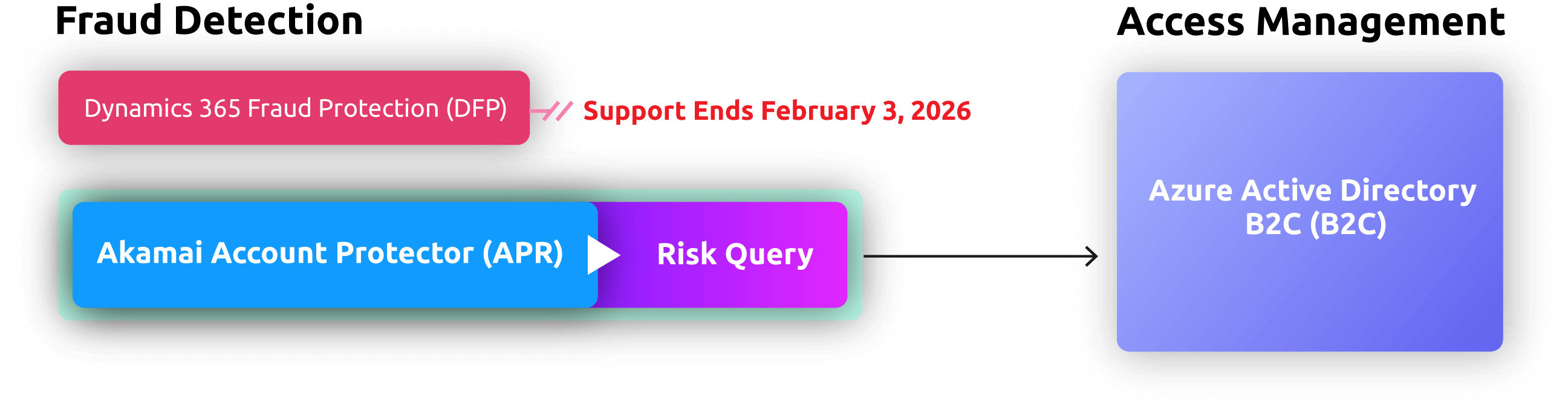
On February 3, 2026, Microsoft will sunset support for Dynamics 365 Fraud Protection (DFP), prompting enterprises to evaluate new fraud prevention strategies. Akamai Account Protector (APR) continues to offer trusted device fingerprints and risk scores, but Azure Active Directory B2C (B2C) does not propagate APR’s risk score header downstream. Risk Query bridges this gap with a lightweight, distributed key-value service that enables APR to write and B2C to read, restoring fraud protection logic.
Solution

Risk Query

Akamai
at Harper
May 12, 2025
Akamai
at Harper
May 12, 2025
Akamai
at Harper
May 12, 2025
May 12, 2025
On February 3, 2026, Microsoft will sunset support for Dynamics 365 Fraud Protection (DFP), prompting enterprises to evaluate new fraud prevention strategies. Akamai Account Protector (APR) continues to offer trusted device fingerprints and risk scores, but Azure Active Directory B2C (B2C) does not propagate APR’s risk score header downstream. Risk Query bridges this gap with a lightweight, distributed key-value service that enables APR to write and B2C to read, restoring fraud protection logic.
Akamai

On February 3, 2026, Microsoft will sunset support for Dynamics 365 Fraud Protection (DFP), prompting enterprises to evaluate new fraud prevention strategies. Akamai Account Protector (APR) continues to offer trusted device fingerprints and risk scores, but Azure Active Directory B2C (B2C) does not propagate APR’s risk score header downstream. Risk Query bridges this gap with a lightweight, distributed key-value service that enables APR to write and B2C to read, restoring fraud protection logic.

Challenges

Header Restrictions

Azure AD B2C permits only a fixed set of headers in its Identity Experience Framework (IEF), blocking APR’s score. 

Looming DFP Retirement

With DFP feature development ending and end-of-life announced, brands need a replacement that works within B2C architectures.


Risk Query Solution

Risk Query provides an integration path between APR and B2C, bypassing header restrictions. Akamai injects fraud scores into a secure high-speed Harper key-value store. B2C reads them using native HTTP policy calls.

Outcomes

Zero Disruption – keep fraud controls after DFP retirement.

Sub-100 ms User Experience – no noticeable latency added to login flow.

Days-not-months Migration – drop-in REST calls; no schema work.

Edge Powered – distributed deployments provide global performance.

On February 3, 2026, Microsoft will sunset support for Dynamics 365 Fraud Protection (DFP), prompting enterprises to evaluate new fraud prevention strategies. Akamai Account Protector (APR) continues to offer trusted device fingerprints and risk scores, but Azure Active Directory B2C (B2C) does not propagate APR’s risk score header downstream. Risk Query bridges this gap with a lightweight, distributed key-value service that enables APR to write and B2C to read, restoring fraud protection logic.

Challenges

Header Restrictions

Azure AD B2C permits only a fixed set of headers in its Identity Experience Framework (IEF), blocking APR’s score. 

Looming DFP Retirement

With DFP feature development ending and end-of-life announced, brands need a replacement that works within B2C architectures.


Risk Query Solution

Risk Query provides an integration path between APR and B2C, bypassing header restrictions. Akamai injects fraud scores into a secure high-speed Harper key-value store. B2C reads them using native HTTP policy calls.

Outcomes

Zero Disruption – keep fraud controls after DFP retirement.

Sub-100 ms User Experience – no noticeable latency added to login flow.

Days-not-months Migration – drop-in REST calls; no schema work.

Edge Powered – distributed deployments provide global performance.

On February 3, 2026, Microsoft will sunset support for Dynamics 365 Fraud Protection (DFP), prompting enterprises to evaluate new fraud prevention strategies. Akamai Account Protector (APR) continues to offer trusted device fingerprints and risk scores, but Azure Active Directory B2C (B2C) does not propagate APR’s risk score header downstream. Risk Query bridges this gap with a lightweight, distributed key-value service that enables APR to write and B2C to read, restoring fraud protection logic.

Download

White arrow pointing right
On February 3, 2026, Microsoft will sunset support for Dynamics 365 Fraud Protection (DFP), prompting enterprises to evaluate new fraud prevention strategies. Akamai Account Protector (APR) continues to offer trusted device fingerprints and risk scores, but Azure Active Directory B2C (B2C) does not propagate APR’s risk score header downstream. Risk Query bridges this gap with a lightweight, distributed key-value service that enables APR to write and B2C to read, restoring fraud protection logic.

Download

White arrow pointing right
On February 3, 2026, Microsoft will sunset support for Dynamics 365 Fraud Protection (DFP), prompting enterprises to evaluate new fraud prevention strategies. Akamai Account Protector (APR) continues to offer trusted device fingerprints and risk scores, but Azure Active Directory B2C (B2C) does not propagate APR’s risk score header downstream. Risk Query bridges this gap with a lightweight, distributed key-value service that enables APR to write and B2C to read, restoring fraud protection logic.

Download

White arrow pointing right

Explore Recent Resources

News
GitHub Logo

Harper Recognized as an Honorable Mention in the 2026 Gartner® Magic Quadrant™ for Cloud-Native Application Platforms

Harper’s inclusion highlights a broader shift toward integrated cloud-native platforms that unify data, caching, messaging, and application logic. The article explains how Harper’s distributed runtime and managed infrastructure reduce operational complexity, improve performance, and support modern applications and AI agents that require fast, reliable access to state, events, and tools.
Announcement
News
Harper’s inclusion highlights a broader shift toward integrated cloud-native platforms that unify data, caching, messaging, and application logic. The article explains how Harper’s distributed runtime and managed infrastructure reduce operational complexity, improve performance, and support modern applications and AI agents that require fast, reliable access to state, events, and tools.
Person with short dark hair and moustache, wearing a colorful plaid shirt, smiling outdoors in a forested mountain landscape.
Aleks Haugom
Senior Manager of GTM
News

Harper Recognized as an Honorable Mention in the 2026 Gartner® Magic Quadrant™ for Cloud-Native Application Platforms

Harper’s inclusion highlights a broader shift toward integrated cloud-native platforms that unify data, caching, messaging, and application logic. The article explains how Harper’s distributed runtime and managed infrastructure reduce operational complexity, improve performance, and support modern applications and AI agents that require fast, reliable access to state, events, and tools.
Aleks Haugom
Aug 2026
News

Harper Recognized as an Honorable Mention in the 2026 Gartner® Magic Quadrant™ for Cloud-Native Application Platforms

Harper’s inclusion highlights a broader shift toward integrated cloud-native platforms that unify data, caching, messaging, and application logic. The article explains how Harper’s distributed runtime and managed infrastructure reduce operational complexity, improve performance, and support modern applications and AI agents that require fast, reliable access to state, events, and tools.
Aleks Haugom
News

Harper Recognized as an Honorable Mention in the 2026 Gartner® Magic Quadrant™ for Cloud-Native Application Platforms

Harper’s inclusion highlights a broader shift toward integrated cloud-native platforms that unify data, caching, messaging, and application logic. The article explains how Harper’s distributed runtime and managed infrastructure reduce operational complexity, improve performance, and support modern applications and AI agents that require fast, reliable access to state, events, and tools.
Aleks Haugom
News
GitHub Logo

Harper 5.2: More Throughput per Node, Fewer Systems Around It

Harper 5.2 helps architecture and platform leaders improve performance, control infrastructure costs, secure production workloads, and reduce operational complexity by bringing faster data access, agentic capabilities, scheduling, backup, routing, and protection into one unified runtime.
Product Update
News
Harper 5.2 helps architecture and platform leaders improve performance, control infrastructure costs, secure production workloads, and reduce operational complexity by bringing faster data access, agentic capabilities, scheduling, backup, routing, and protection into one unified runtime.
Person with short dark hair and moustache, wearing a colorful plaid shirt, smiling outdoors in a forested mountain landscape.
Aleks Haugom
Senior Manager of GTM
News

Harper 5.2: More Throughput per Node, Fewer Systems Around It

Harper 5.2 helps architecture and platform leaders improve performance, control infrastructure costs, secure production workloads, and reduce operational complexity by bringing faster data access, agentic capabilities, scheduling, backup, routing, and protection into one unified runtime.
Aleks Haugom
Aug 2026
News

Harper 5.2: More Throughput per Node, Fewer Systems Around It

Harper 5.2 helps architecture and platform leaders improve performance, control infrastructure costs, secure production workloads, and reduce operational complexity by bringing faster data access, agentic capabilities, scheduling, backup, routing, and protection into one unified runtime.
Aleks Haugom
News

Harper 5.2: More Throughput per Node, Fewer Systems Around It

Harper 5.2 helps architecture and platform leaders improve performance, control infrastructure costs, secure production workloads, and reduce operational complexity by bringing faster data access, agentic capabilities, scheduling, backup, routing, and protection into one unified runtime.
Aleks Haugom
Blog
GitHub Logo

5 Architectures for Web Personalization

Personalization is a data-delivery problem. Every architectural choice reduces to two distances: compute to user, and compute to fresh data. This piece maps five real architectures against both axes, scored on a concrete retailer workload where stale or slow data breaks the business.
Blog
Personalization is a data-delivery problem. Every architectural choice reduces to two distances: compute to user, and compute to fresh data. This piece maps five real architectures against both axes, scored on a concrete retailer workload where stale or slow data breaks the business.
Person with short dark hair and moustache, wearing a colorful plaid shirt, smiling outdoors in a forested mountain landscape.
Aleks Haugom
Senior Manager of GTM
Blog

5 Architectures for Web Personalization

Personalization is a data-delivery problem. Every architectural choice reduces to two distances: compute to user, and compute to fresh data. This piece maps five real architectures against both axes, scored on a concrete retailer workload where stale or slow data breaks the business.
Aleks Haugom
Jul 2026
Blog

5 Architectures for Web Personalization

Personalization is a data-delivery problem. Every architectural choice reduces to two distances: compute to user, and compute to fresh data. This piece maps five real architectures against both axes, scored on a concrete retailer workload where stale or slow data breaks the business.
Aleks Haugom
Blog

5 Architectures for Web Personalization

Personalization is a data-delivery problem. Every architectural choice reduces to two distances: compute to user, and compute to fresh data. This piece maps five real architectures against both axes, scored on a concrete retailer workload where stale or slow data breaks the business.
Aleks Haugom