



Click Below to Get the Code

Browse, clone, and build from real-world templates powered by Harper.
Solution
GitHub Logo

Page Cache

Page Cache delivers sub-second product pages by accepting your existing SSR or static framework, pre-rendering where it helps, and injecting dynamic attributes (price, availability, promos, personalization) at the last responsible moment—often hitting ~600 ms for 95% of users. Running on Harper’s unified platform, it serves fully formed pages from the edge with minimal code change, simplifying infrastructure while improving SEO, conversions, and global reliability.
Solution

Page Cache

Harper
at Harper
September 2, 2025
Harper
at Harper
September 2, 2025
Harper
at Harper
September 2, 2025
September 2, 2025
Page Cache delivers sub-second product pages by accepting your existing SSR or static framework, pre-rendering where it helps, and injecting dynamic attributes (price, availability, promos, personalization) at the last responsible moment—often hitting ~600 ms for 95% of users. Running on Harper’s unified platform, it serves fully formed pages from the edge with minimal code change, simplifying infrastructure while improving SEO, conversions, and global reliability.
Harper

When a shopper taps “Buy,” the page should already be ready. Page Cache accepts your framework as-is, supporting both server-side rendered and static origins, and adds pre-rendering or dynamic attributes only where they are beneficial. Either way, you get instant, current pages with minimal code change and a deployment plan that fits your roadmap.

Problem

Every product page starts its life as a template, then begs data systems for prices, inventory, promos, recommendations, and content fragments. Traditional “HTML + CDN” helps with assets, but whenever those dynamic bits are missing, the page slows. Teams layer on microservices, sprinkle in edge logic, and still chase cold starts, cache misses, and origin bottlenecks. You feel it as SEO decay, conversion drag, and operational sprawl. The customer feels it as wait time.

Page Cache Solution

Page Cache enables full page load in as little as 600ms or less for 95% of users. To accomplish this, we generate or accept a complete page (framework-rendered or pre-rendered), enrich it with dynamic attributes at the last responsible moment (price, availability, personalization, promotions), and cache the finished experience as a first-class artifact that can be served from the closest point to the user. Because Page Cache runs on Harper’s platform, with database, cache, application, and messaging systems in a single runtime, it avoids multi-server slowdowns and costly operational sprawl, common with alternative solutions.

Page Cache can:

- Pre-render pages for instant first paint and stronger crawlability.
- Inject dynamic attributes
without a round trip to fragile origin paths.
- Deliver globally
from dedicated, predictable infrastructure.
- Work push or pull
: push rendered pages into Page Cache from your pipeline, or let Page Cache pull from your origin and materialize the final, cacheable result.
- Scale simply
as traffic, personalization, or catalog depth grows.
- (Advanced) Host frameworks directly
— unify modern app frameworks (e.g., React/Next) with Page Cache to minimize networking hops, simplify infrastructure, and cut costs.
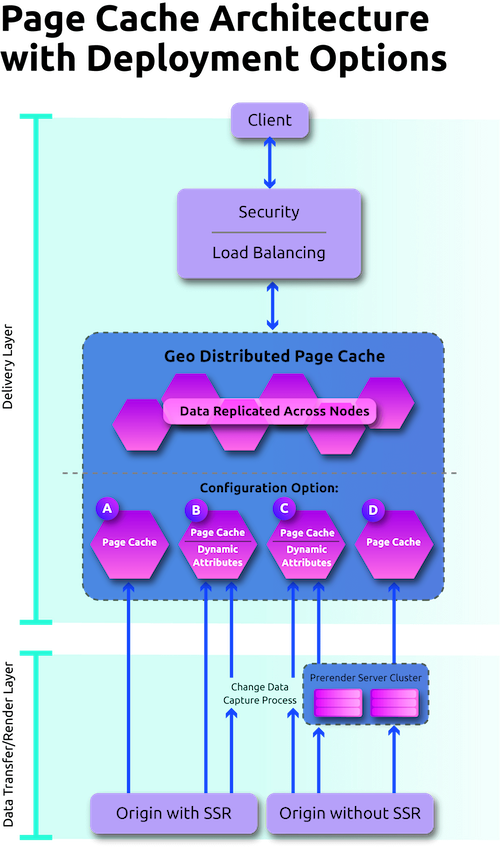
Why Page Cache Works

Page Cache works because it delivers the final, complete experience—not fragments. Pre-rendering eliminates assembly, attribute injection brings personalization into the delivery path, and Harper’s global footprint removes the network drag that slows conversions. Fewer moving parts mean simpler operations, faster iteration, and customers who never wait for your architecture to catch up.

Adopt Page Cache all at once for maximum ROI on day one or plan it out over a few sprints. Either way, the outcome is the same: pages that are fully formed, always current, and instantly delivered.

Contact the Harper sales team at hello@harperdb.io to get started.

When a shopper taps “Buy,” the page should already be ready. Page Cache accepts your framework as-is, supporting both server-side rendered and static origins, and adds pre-rendering or dynamic attributes only where they are beneficial. Either way, you get instant, current pages with minimal code change and a deployment plan that fits your roadmap.

Problem

Every product page starts its life as a template, then begs data systems for prices, inventory, promos, recommendations, and content fragments. Traditional “HTML + CDN” helps with assets, but whenever those dynamic bits are missing, the page slows. Teams layer on microservices, sprinkle in edge logic, and still chase cold starts, cache misses, and origin bottlenecks. You feel it as SEO decay, conversion drag, and operational sprawl. The customer feels it as wait time.

Page Cache Solution

Page Cache enables full page load in as little as 600ms or less for 95% of users. To accomplish this, we generate or accept a complete page (framework-rendered or pre-rendered), enrich it with dynamic attributes at the last responsible moment (price, availability, personalization, promotions), and cache the finished experience as a first-class artifact that can be served from the closest point to the user. Because Page Cache runs on Harper’s platform, with database, cache, application, and messaging systems in a single runtime, it avoids multi-server slowdowns and costly operational sprawl, common with alternative solutions.

Page Cache can:

- Pre-render pages for instant first paint and stronger crawlability.
- Inject dynamic attributes
without a round trip to fragile origin paths.
- Deliver globally
from dedicated, predictable infrastructure.
- Work push or pull
: push rendered pages into Page Cache from your pipeline, or let Page Cache pull from your origin and materialize the final, cacheable result.
- Scale simply
as traffic, personalization, or catalog depth grows.
- (Advanced) Host frameworks directly
— unify modern app frameworks (e.g., React/Next) with Page Cache to minimize networking hops, simplify infrastructure, and cut costs.

Why Page Cache Works

Page Cache works because it delivers the final, complete experience—not fragments. Pre-rendering eliminates assembly, attribute injection brings personalization into the delivery path, and Harper’s global footprint removes the network drag that slows conversions. Fewer moving parts mean simpler operations, faster iteration, and customers who never wait for your architecture to catch up.

Adopt Page Cache all at once for maximum ROI on day one or plan it out over a few sprints. Either way, the outcome is the same: pages that are fully formed, always current, and instantly delivered.

Contact the Harper sales team at hello@harperdb.io to get started.

Page Cache delivers sub-second product pages by accepting your existing SSR or static framework, pre-rendering where it helps, and injecting dynamic attributes (price, availability, promos, personalization) at the last responsible moment—often hitting ~600 ms for 95% of users. Running on Harper’s unified platform, it serves fully formed pages from the edge with minimal code change, simplifying infrastructure while improving SEO, conversions, and global reliability.

Download

White arrow pointing right
Page Cache delivers sub-second product pages by accepting your existing SSR or static framework, pre-rendering where it helps, and injecting dynamic attributes (price, availability, promos, personalization) at the last responsible moment—often hitting ~600 ms for 95% of users. Running on Harper’s unified platform, it serves fully formed pages from the edge with minimal code change, simplifying infrastructure while improving SEO, conversions, and global reliability.

Download

White arrow pointing right
Page Cache delivers sub-second product pages by accepting your existing SSR or static framework, pre-rendering where it helps, and injecting dynamic attributes (price, availability, promos, personalization) at the last responsible moment—often hitting ~600 ms for 95% of users. Running on Harper’s unified platform, it serves fully formed pages from the edge with minimal code change, simplifying infrastructure while improving SEO, conversions, and global reliability.

Download

White arrow pointing right

Explore Recent Resources

News
GitHub Logo

Harper Recognized as an Honorable Mention in the 2026 Gartner® Magic Quadrant™ for Cloud-Native Application Platforms

Harper’s inclusion highlights a broader shift toward integrated cloud-native platforms that unify data, caching, messaging, and application logic. The article explains how Harper’s distributed runtime and managed infrastructure reduce operational complexity, improve performance, and support modern applications and AI agents that require fast, reliable access to state, events, and tools.
Announcement
News
Harper’s inclusion highlights a broader shift toward integrated cloud-native platforms that unify data, caching, messaging, and application logic. The article explains how Harper’s distributed runtime and managed infrastructure reduce operational complexity, improve performance, and support modern applications and AI agents that require fast, reliable access to state, events, and tools.
Person with short dark hair and moustache, wearing a colorful plaid shirt, smiling outdoors in a forested mountain landscape.
Aleks Haugom
Senior Manager of GTM
News

Harper Recognized as an Honorable Mention in the 2026 Gartner® Magic Quadrant™ for Cloud-Native Application Platforms

Harper’s inclusion highlights a broader shift toward integrated cloud-native platforms that unify data, caching, messaging, and application logic. The article explains how Harper’s distributed runtime and managed infrastructure reduce operational complexity, improve performance, and support modern applications and AI agents that require fast, reliable access to state, events, and tools.
Aleks Haugom
Aug 2026
News

Harper Recognized as an Honorable Mention in the 2026 Gartner® Magic Quadrant™ for Cloud-Native Application Platforms

Harper’s inclusion highlights a broader shift toward integrated cloud-native platforms that unify data, caching, messaging, and application logic. The article explains how Harper’s distributed runtime and managed infrastructure reduce operational complexity, improve performance, and support modern applications and AI agents that require fast, reliable access to state, events, and tools.
Aleks Haugom
News

Harper Recognized as an Honorable Mention in the 2026 Gartner® Magic Quadrant™ for Cloud-Native Application Platforms

Harper’s inclusion highlights a broader shift toward integrated cloud-native platforms that unify data, caching, messaging, and application logic. The article explains how Harper’s distributed runtime and managed infrastructure reduce operational complexity, improve performance, and support modern applications and AI agents that require fast, reliable access to state, events, and tools.
Aleks Haugom
News
GitHub Logo

Harper 5.2: More Throughput per Node, Fewer Systems Around It

Harper 5.2 helps architecture and platform leaders improve performance, control infrastructure costs, secure production workloads, and reduce operational complexity by bringing faster data access, agentic capabilities, scheduling, backup, routing, and protection into one unified runtime.
Product Update
News
Harper 5.2 helps architecture and platform leaders improve performance, control infrastructure costs, secure production workloads, and reduce operational complexity by bringing faster data access, agentic capabilities, scheduling, backup, routing, and protection into one unified runtime.
Person with short dark hair and moustache, wearing a colorful plaid shirt, smiling outdoors in a forested mountain landscape.
Aleks Haugom
Senior Manager of GTM
News

Harper 5.2: More Throughput per Node, Fewer Systems Around It

Harper 5.2 helps architecture and platform leaders improve performance, control infrastructure costs, secure production workloads, and reduce operational complexity by bringing faster data access, agentic capabilities, scheduling, backup, routing, and protection into one unified runtime.
Aleks Haugom
Aug 2026
News

Harper 5.2: More Throughput per Node, Fewer Systems Around It

Harper 5.2 helps architecture and platform leaders improve performance, control infrastructure costs, secure production workloads, and reduce operational complexity by bringing faster data access, agentic capabilities, scheduling, backup, routing, and protection into one unified runtime.
Aleks Haugom
News

Harper 5.2: More Throughput per Node, Fewer Systems Around It

Harper 5.2 helps architecture and platform leaders improve performance, control infrastructure costs, secure production workloads, and reduce operational complexity by bringing faster data access, agentic capabilities, scheduling, backup, routing, and protection into one unified runtime.
Aleks Haugom
Blog
GitHub Logo

5 Architectures for Web Personalization

Personalization is a data-delivery problem. Every architectural choice reduces to two distances: compute to user, and compute to fresh data. This piece maps five real architectures against both axes, scored on a concrete retailer workload where stale or slow data breaks the business.
Blog
Personalization is a data-delivery problem. Every architectural choice reduces to two distances: compute to user, and compute to fresh data. This piece maps five real architectures against both axes, scored on a concrete retailer workload where stale or slow data breaks the business.
Person with short dark hair and moustache, wearing a colorful plaid shirt, smiling outdoors in a forested mountain landscape.
Aleks Haugom
Senior Manager of GTM
Blog

5 Architectures for Web Personalization

Personalization is a data-delivery problem. Every architectural choice reduces to two distances: compute to user, and compute to fresh data. This piece maps five real architectures against both axes, scored on a concrete retailer workload where stale or slow data breaks the business.
Aleks Haugom
Jul 2026
Blog

5 Architectures for Web Personalization

Personalization is a data-delivery problem. Every architectural choice reduces to two distances: compute to user, and compute to fresh data. This piece maps five real architectures against both axes, scored on a concrete retailer workload where stale or slow data breaks the business.
Aleks Haugom
Blog

5 Architectures for Web Personalization

Personalization is a data-delivery problem. Every architectural choice reduces to two distances: compute to user, and compute to fresh data. This piece maps five real architectures against both axes, scored on a concrete retailer workload where stale or slow data breaks the business.
Aleks Haugom