



Click Below to Get the Code

Browse, clone, and build from real-world templates powered by Harper.
Blog
GitHub Logo

Happy Thanksgiving! Here is an AI-Coded Harper Game for Your Day Off

Discover how Harper’s unified application platform and AI-first development tools make it possible for anyone—even non-developers—to build and deploy real apps. In this Thanksgiving story, follow the journey of creating a fun Pac-Man-style game using Google’s Antigravity IDE, Gemini, Claude, and Harper’s open-source templates. Learn how Harper simplifies backend development, accelerates AI-driven coding, and unlocks creativity with seamless deployment on Harper Fabric. Play the game and experience the power of Harper for modern app development.
Blog

Happy Thanksgiving! Here is an AI-Coded Harper Game for Your Day Off

Aleks Haugom
Senior Manager of GTM
at Harper
November 27, 2025
Aleks Haugom
Senior Manager of GTM
at Harper
November 27, 2025
Aleks Haugom
Senior Manager of GTM
at Harper
November 27, 2025
November 27, 2025
Discover how Harper’s unified application platform and AI-first development tools make it possible for anyone—even non-developers—to build and deploy real apps. In this Thanksgiving story, follow the journey of creating a fun Pac-Man-style game using Google’s Antigravity IDE, Gemini, Claude, and Harper’s open-source templates. Learn how Harper simplifies backend development, accelerates AI-driven coding, and unlocks creativity with seamless deployment on Harper Fabric. Play the game and experience the power of Harper for modern app development.
Aleks Haugom
Senior Manager of GTM

This Thanksgiving, I’m feeling especially grateful—and a little amazed—because I finally did something I’ve watched our community do for years: I built my own app with Harper. No coding background, no prior experience. I work in Marketing, after all…

All I really had was an idea and the determination to look at my computer every 20 minutes or so to approve whatever the AI wanted to try next. It was my first true dive into vibe coding using Google’s AI-native Integrated Development Environment, Antigravity —kind of like VS Code, but with deeply integrated AI.

I shared the Harper open-source repository with it, paired with our application template. Beyond that, I simply dictated what I wanted to ChatGPT and asked it to turn those thoughts into requirements for Antigravity to build from.

Inside Antigravity, I bounced between Gemini 3, Claude Sonnet 4.5, and whichever thinking model still had credits left. The whole thing became a rhythm of testing, describing updates, testing again, and refining further—a full vibe-driven marathon that I ran in between building a fence in my backyard. The AIs would often think and work for 20–30 minutes at a time, so I just kept an eye on things, clicked “accept” whenever needed, and clarified what was broken.

The result is a Thanksgiving game: a little Pac-Man-style maze where you dodge angry turkey emojis, collect Thanksgiving food, and race through five increasingly chaotic levels. I made it to level four before getting steamrolled. Maybe you’ll fare better. I still have no idea what the end screen looks like.
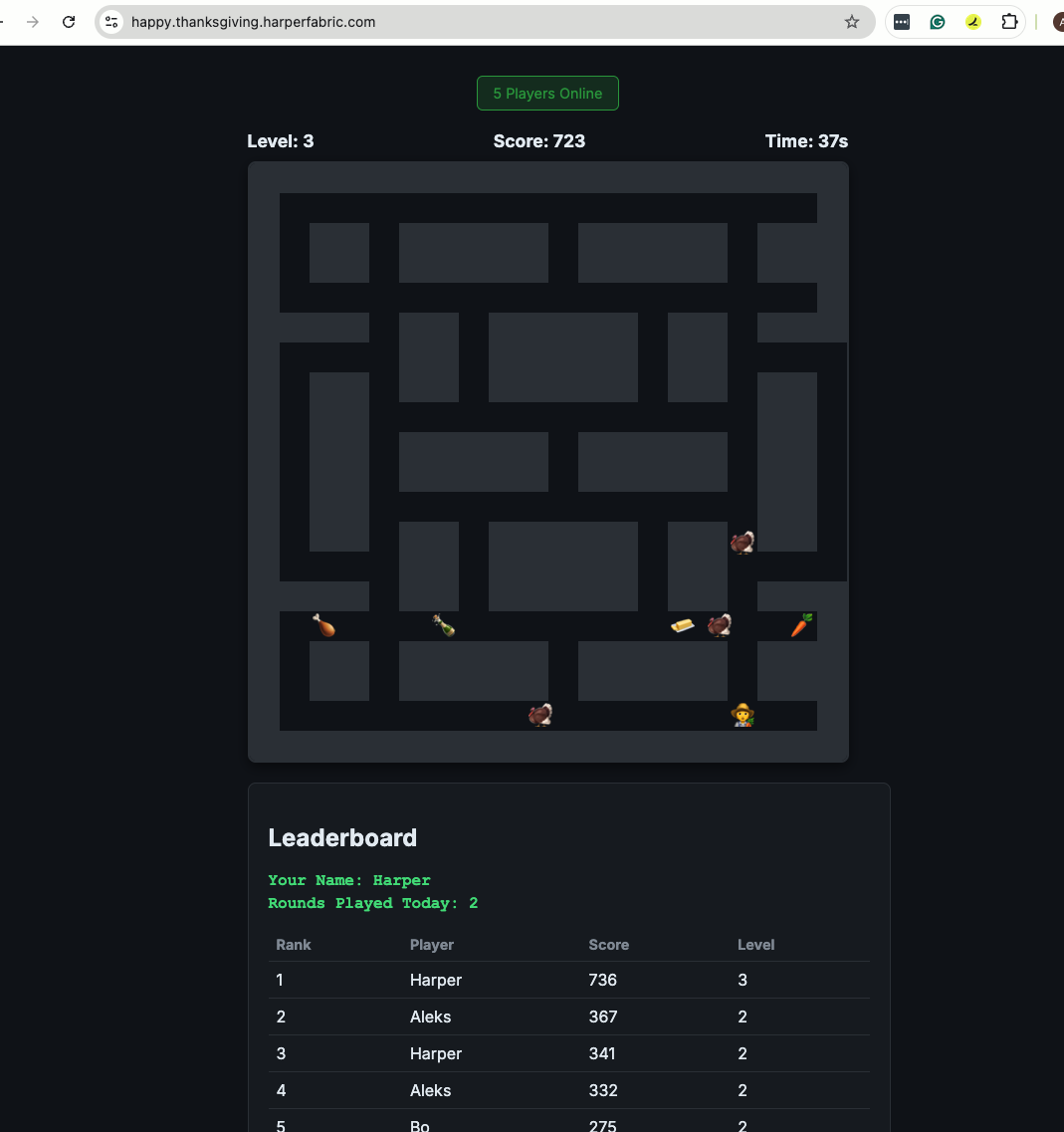
Thanksgiving Maze game built with Google Antigravity and Harper, deployed on Harper Farbic

Behind the scenes, the app uses CRDT counters to track how many people are “online” (really: how many browser tabs you’ve opened). There’s also a leaderboard that updates every ~15 seconds via polling—because, candidly, real-time WebSockets defeated both me and the AI. And in true holiday-miracle fashion, once the repo was ready, deploying it to Harper Fabric was free and as simple as pasting in the GitHub URL, clicking import, and restarting the cluster. You can play it live at: https://happy.thanksgiving.harperfabric.com/

The AI even helped me set up my GitHub account, install npm, and all the other “basic” things I’ve somehow avoided until now.

What I’m most thankful for this year is realizing that ideas no longer sit behind the wall of technical complexity. With an AI-first IDE and a unified platform like Harper—where database, cache, messaging, and application logic all live together—building becomes less about wrestling with systems and more about expressing imagination. Maybe this is what the next renaissance of software looks like.

Perhaps Harper is becoming the first Integrated Development Technology—the missing counterpart to the Integrated Development Environments developers have used for decades.

Wishing you rest, joy, time with the people you love—and a high score on the leaderboard.

Happy Thanksgiving!

This Thanksgiving, I’m feeling especially grateful—and a little amazed—because I finally did something I’ve watched our community do for years: I built my own app with Harper. No coding background, no prior experience. I work in Marketing, after all…

All I really had was an idea and the determination to look at my computer every 20 minutes or so to approve whatever the AI wanted to try next. It was my first true dive into vibe coding using Google’s AI-native Integrated Development Environment, Antigravity —kind of like VS Code, but with deeply integrated AI.

I shared the Harper open-source repository with it, paired with our application template. Beyond that, I simply dictated what I wanted to ChatGPT and asked it to turn those thoughts into requirements for Antigravity to build from.

Inside Antigravity, I bounced between Gemini 3, Claude Sonnet 4.5, and whichever thinking model still had credits left. The whole thing became a rhythm of testing, describing updates, testing again, and refining further—a full vibe-driven marathon that I ran in between building a fence in my backyard. The AIs would often think and work for 20–30 minutes at a time, so I just kept an eye on things, clicked “accept” whenever needed, and clarified what was broken.

The result is a Thanksgiving game: a little Pac-Man-style maze where you dodge angry turkey emojis, collect Thanksgiving food, and race through five increasingly chaotic levels. I made it to level four before getting steamrolled. Maybe you’ll fare better. I still have no idea what the end screen looks like.

Thanksgiving Maze game built with Google Antigravity and Harper, deployed on Harper Farbic

Behind the scenes, the app uses CRDT counters to track how many people are “online” (really: how many browser tabs you’ve opened). There’s also a leaderboard that updates every ~15 seconds via polling—because, candidly, real-time WebSockets defeated both me and the AI. And in true holiday-miracle fashion, once the repo was ready, deploying it to Harper Fabric was free and as simple as pasting in the GitHub URL, clicking import, and restarting the cluster. You can play it live at: https://happy.thanksgiving.harperfabric.com/

The AI even helped me set up my GitHub account, install npm, and all the other “basic” things I’ve somehow avoided until now.

What I’m most thankful for this year is realizing that ideas no longer sit behind the wall of technical complexity. With an AI-first IDE and a unified platform like Harper—where database, cache, messaging, and application logic all live together—building becomes less about wrestling with systems and more about expressing imagination. Maybe this is what the next renaissance of software looks like.

Perhaps Harper is becoming the first Integrated Development Technology—the missing counterpart to the Integrated Development Environments developers have used for decades.

Wishing you rest, joy, time with the people you love—and a high score on the leaderboard.

Happy Thanksgiving!

Discover how Harper’s unified application platform and AI-first development tools make it possible for anyone—even non-developers—to build and deploy real apps. In this Thanksgiving story, follow the journey of creating a fun Pac-Man-style game using Google’s Antigravity IDE, Gemini, Claude, and Harper’s open-source templates. Learn how Harper simplifies backend development, accelerates AI-driven coding, and unlocks creativity with seamless deployment on Harper Fabric. Play the game and experience the power of Harper for modern app development.

Download

White arrow pointing right
Discover how Harper’s unified application platform and AI-first development tools make it possible for anyone—even non-developers—to build and deploy real apps. In this Thanksgiving story, follow the journey of creating a fun Pac-Man-style game using Google’s Antigravity IDE, Gemini, Claude, and Harper’s open-source templates. Learn how Harper simplifies backend development, accelerates AI-driven coding, and unlocks creativity with seamless deployment on Harper Fabric. Play the game and experience the power of Harper for modern app development.

Download

White arrow pointing right
Discover how Harper’s unified application platform and AI-first development tools make it possible for anyone—even non-developers—to build and deploy real apps. In this Thanksgiving story, follow the journey of creating a fun Pac-Man-style game using Google’s Antigravity IDE, Gemini, Claude, and Harper’s open-source templates. Learn how Harper simplifies backend development, accelerates AI-driven coding, and unlocks creativity with seamless deployment on Harper Fabric. Play the game and experience the power of Harper for modern app development.

Download

White arrow pointing right

Explore Recent Resources

News
GitHub Logo

Harper Recognized as an Honorable Mention in the 2026 Gartner® Magic Quadrant™ for Cloud-Native Application Platforms

Harper’s inclusion highlights a broader shift toward integrated cloud-native platforms that unify data, caching, messaging, and application logic. The article explains how Harper’s distributed runtime and managed infrastructure reduce operational complexity, improve performance, and support modern applications and AI agents that require fast, reliable access to state, events, and tools.
Announcement
News
Harper’s inclusion highlights a broader shift toward integrated cloud-native platforms that unify data, caching, messaging, and application logic. The article explains how Harper’s distributed runtime and managed infrastructure reduce operational complexity, improve performance, and support modern applications and AI agents that require fast, reliable access to state, events, and tools.
Person with short dark hair and moustache, wearing a colorful plaid shirt, smiling outdoors in a forested mountain landscape.
Aleks Haugom
Senior Manager of GTM
News

Harper Recognized as an Honorable Mention in the 2026 Gartner® Magic Quadrant™ for Cloud-Native Application Platforms

Harper’s inclusion highlights a broader shift toward integrated cloud-native platforms that unify data, caching, messaging, and application logic. The article explains how Harper’s distributed runtime and managed infrastructure reduce operational complexity, improve performance, and support modern applications and AI agents that require fast, reliable access to state, events, and tools.
Aleks Haugom
Aug 2026
News

Harper Recognized as an Honorable Mention in the 2026 Gartner® Magic Quadrant™ for Cloud-Native Application Platforms

Harper’s inclusion highlights a broader shift toward integrated cloud-native platforms that unify data, caching, messaging, and application logic. The article explains how Harper’s distributed runtime and managed infrastructure reduce operational complexity, improve performance, and support modern applications and AI agents that require fast, reliable access to state, events, and tools.
Aleks Haugom
News

Harper Recognized as an Honorable Mention in the 2026 Gartner® Magic Quadrant™ for Cloud-Native Application Platforms

Harper’s inclusion highlights a broader shift toward integrated cloud-native platforms that unify data, caching, messaging, and application logic. The article explains how Harper’s distributed runtime and managed infrastructure reduce operational complexity, improve performance, and support modern applications and AI agents that require fast, reliable access to state, events, and tools.
Aleks Haugom
News
GitHub Logo

Harper 5.2: More Throughput per Node, Fewer Systems Around It

Harper 5.2 helps architecture and platform leaders improve performance, control infrastructure costs, secure production workloads, and reduce operational complexity by bringing faster data access, agentic capabilities, scheduling, backup, routing, and protection into one unified runtime.
Product Update
News
Harper 5.2 helps architecture and platform leaders improve performance, control infrastructure costs, secure production workloads, and reduce operational complexity by bringing faster data access, agentic capabilities, scheduling, backup, routing, and protection into one unified runtime.
Person with short dark hair and moustache, wearing a colorful plaid shirt, smiling outdoors in a forested mountain landscape.
Aleks Haugom
Senior Manager of GTM
News

Harper 5.2: More Throughput per Node, Fewer Systems Around It

Harper 5.2 helps architecture and platform leaders improve performance, control infrastructure costs, secure production workloads, and reduce operational complexity by bringing faster data access, agentic capabilities, scheduling, backup, routing, and protection into one unified runtime.
Aleks Haugom
Aug 2026
News

Harper 5.2: More Throughput per Node, Fewer Systems Around It

Harper 5.2 helps architecture and platform leaders improve performance, control infrastructure costs, secure production workloads, and reduce operational complexity by bringing faster data access, agentic capabilities, scheduling, backup, routing, and protection into one unified runtime.
Aleks Haugom
News

Harper 5.2: More Throughput per Node, Fewer Systems Around It

Harper 5.2 helps architecture and platform leaders improve performance, control infrastructure costs, secure production workloads, and reduce operational complexity by bringing faster data access, agentic capabilities, scheduling, backup, routing, and protection into one unified runtime.
Aleks Haugom
Blog
GitHub Logo

5 Architectures for Web Personalization

Personalization is a data-delivery problem. Every architectural choice reduces to two distances: compute to user, and compute to fresh data. This piece maps five real architectures against both axes, scored on a concrete retailer workload where stale or slow data breaks the business.
Blog
Personalization is a data-delivery problem. Every architectural choice reduces to two distances: compute to user, and compute to fresh data. This piece maps five real architectures against both axes, scored on a concrete retailer workload where stale or slow data breaks the business.
Person with short dark hair and moustache, wearing a colorful plaid shirt, smiling outdoors in a forested mountain landscape.
Aleks Haugom
Senior Manager of GTM
Blog

5 Architectures for Web Personalization

Personalization is a data-delivery problem. Every architectural choice reduces to two distances: compute to user, and compute to fresh data. This piece maps five real architectures against both axes, scored on a concrete retailer workload where stale or slow data breaks the business.
Aleks Haugom
Jul 2026
Blog

5 Architectures for Web Personalization

Personalization is a data-delivery problem. Every architectural choice reduces to two distances: compute to user, and compute to fresh data. This piece maps five real architectures against both axes, scored on a concrete retailer workload where stale or slow data breaks the business.
Aleks Haugom
Blog

5 Architectures for Web Personalization

Personalization is a data-delivery problem. Every architectural choice reduces to two distances: compute to user, and compute to fresh data. This piece maps five real architectures against both axes, scored on a concrete retailer workload where stale or slow data breaks the business.
Aleks Haugom